Physics Intelligence for Robot Design and Learning
Combine SolverX physics foundation models with your computational models and experimental data to predict structural, contact, and actuation responses. Apply calibrated response models to robot design, validation, and learning to explore target performance and reduce task-relevant sim-to-real discrepancies.
Talk to an Expert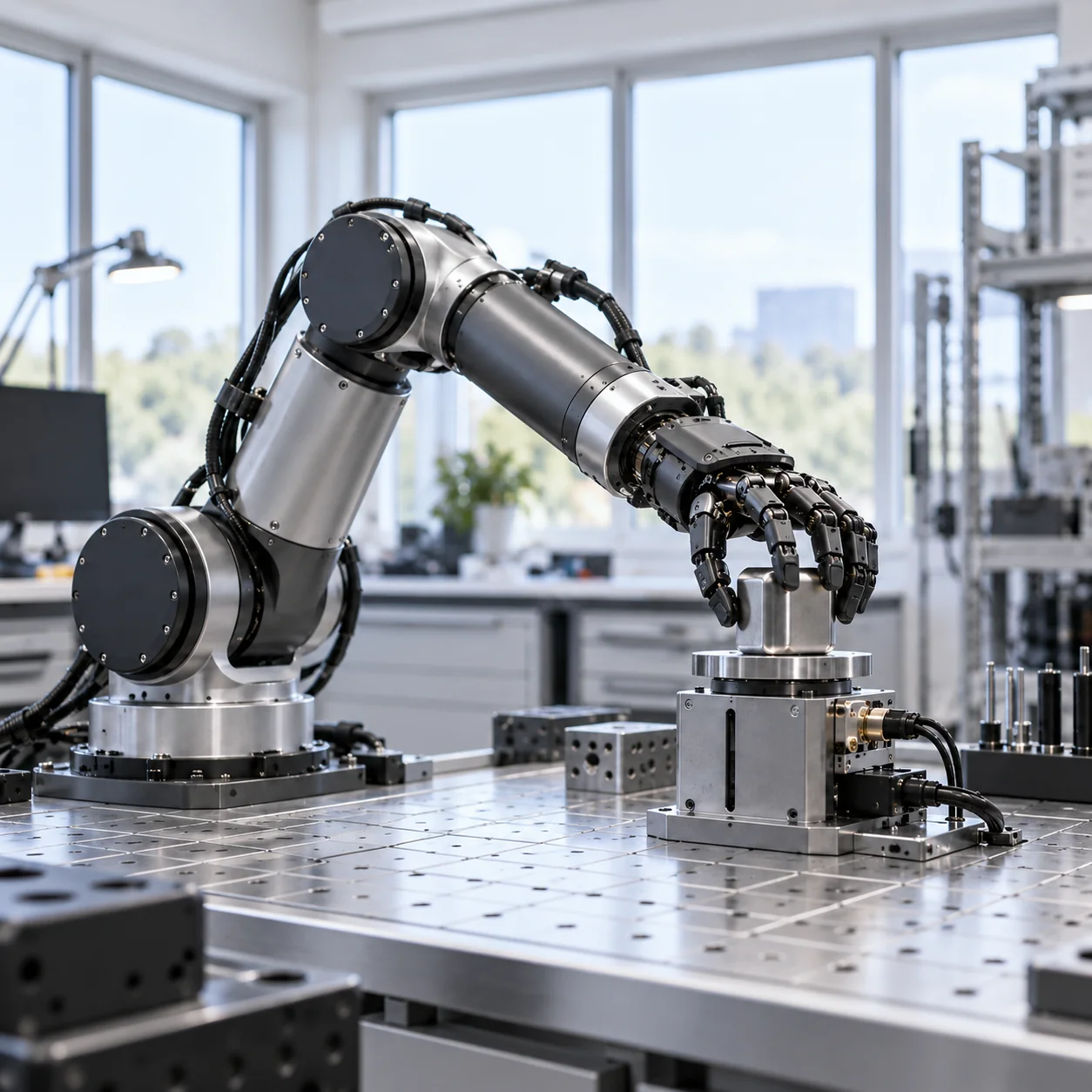
Shared Foundation Across Industries
Applications
Connect SolverX Physics Intelligence, built on our physics foundation models, with your computational models and experimental data. Apply tailored models of structural, contact, and thermal behavior to robot design, validation, and learning, helping you evaluate physical characteristics against target performance.
Physics Assets & Robot Learning
Organize geometry, physical properties, and condition-dependent response models into Physics Assets for robot simulation and learning. Calibrate these models against hardware data to reduce sim-to-real discrepancies in the motion, forces, and contact responses that matter to your task.
Actuator Multiphysics
Evaluate electromagnetic forces and losses alongside actuator temperature, stress, and deformation under changing drive conditions. Connect your electromagnetic and finite-element models with test data to explore designs against actuation performance, stiffness, mass, and thermal requirements.
Structural Vibration & Fatigue
Predict natural frequencies, mode shapes, and dynamic stresses across robot configurations, support conditions, and loading histories. Connect these responses with your fatigue assessment models, material data, and tests to compare cyclic loading effects and refine geometry, stiffness, and mass distribution.
Hand Architecture & Contact Mechanics
Compare degrees of freedom, joint layouts, actuation, and transmission architectures to evaluate motion range and force transmission. Connect kinematic and multibody models with solid and contact mechanics to predict deformation, contact forces, and compliance, and explore geometry, materials, and actuation for target grasping performance.